Overview
Governance in AI is no longer a back office formality. For market leaders, it shapes valuation, dictates regulatory agility and signals operational discipline. The RADAR Governance model, short for Regulatory AI Due diligence and Accountability Rating, scores companies across ORBIT (internal systems) and ECHO (external signals). The composite condenses scattered controls into a single, market readable number.
Key takeaways
- Names above 8.5 trade with governance as a premium factor, often reflected in smoother audit cycles and lower compliance drag.
- Balanced ORBIT ECHO profiles tend to win faster regulator sign offs and partner trust in sensitive sectors.
- Governance maturity increasingly correlates with tighter spreads on capital raises.
Method notes
- Draws from public filings, governance frameworks, transparency reports and policy engagement records.
- ORBIT maps structural and procedural depth. ECHO measures disclosure quality and credibility in the market.
- Scores are indicative snapshots, adjusted as fresh disclosures surface.
Governance leaderboard
| Company | ORBIT | ECHO | Composite | Commentary |
|---|---|---|---|---|
| Microsoft AI | 9.2 | 8.8 | 9.0 | Board level AI oversight, SEC grade disclosure and embedded risk reviews keep it ahead. Copilot’s scale up will test change controls. |
| Google DeepMind | 9.0 | 7.5 | 8.3 | Strong technical governance underpins ORBIT. Limited public reporting keeps ECHO muted. |
| Anthropic | 8.7 | 9.1 | 8.9 | Constitutional AI playbook and steady policy engagement earn it a governance premium. |
| OpenAI | 8.0 | 8.6 | 8.3 | High transparency output supports ECHO. Board volatility still weighs on ORBIT stability. |
| Meta AI | 8.4 | 7.2 | 7.8 | Scaled compliance infrastructure keeps ORBIT solid. Legacy trust deficits hold back ECHO. |
Score visualization
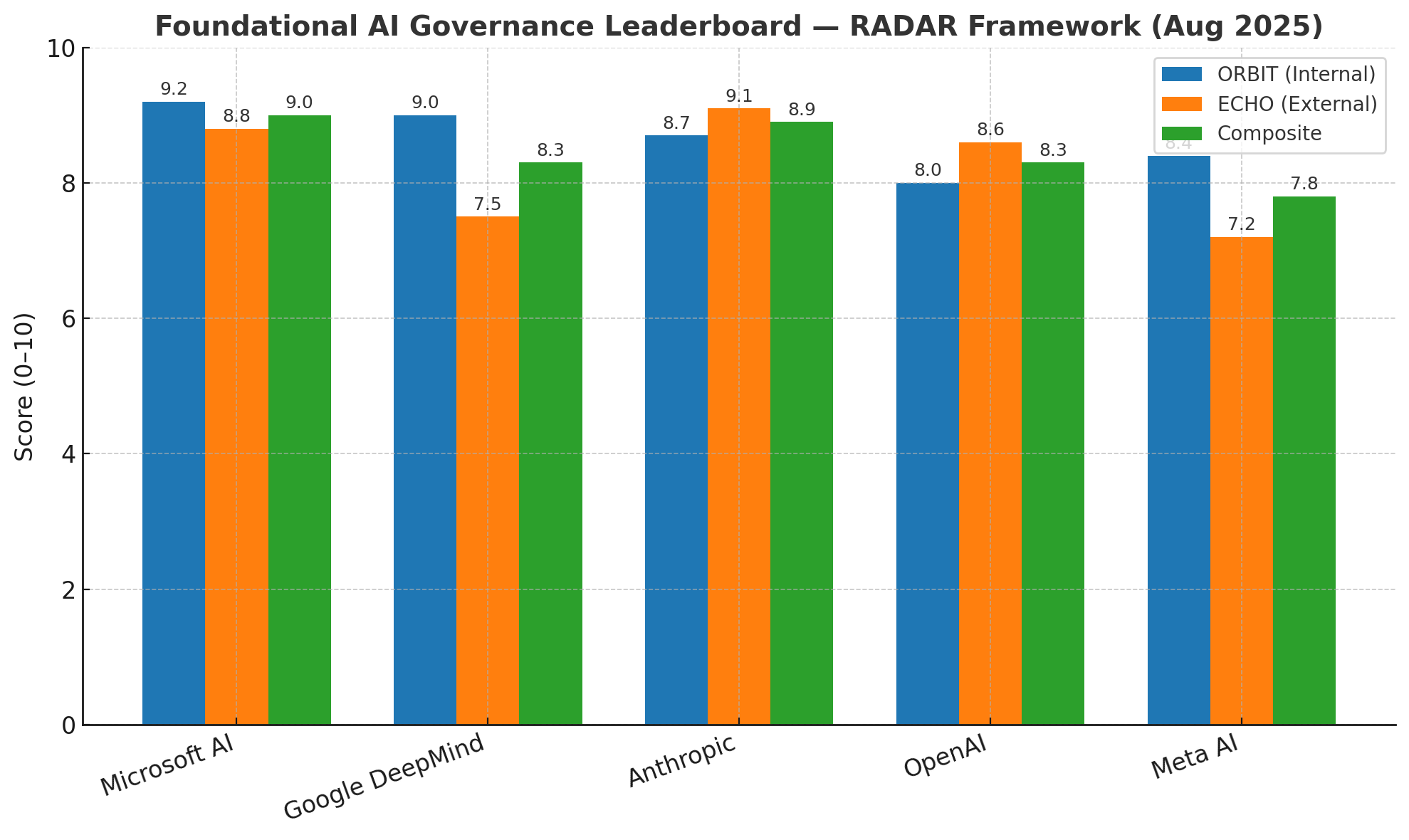
ORBIT gauges internal discipline. ECHO tracks market facing accountability. Composite blends both into one metric.
Company snapshots
- Microsoft marries disciplined audit trails with aggressive product integration. Eyes on Copilot governance will be key.
- Anthropic enjoys regulatory goodwill from a codified governance doctrine and consistent policy presence.
- Google DeepMind runs deep internal checks; more structured public disclosure could lift market trust scores.
- OpenAI leverages documentation to sustain credibility; governance stability will be the swing factor.
- Meta AI strengthens oversight at scale, but sentiment overhang remains in sensitive markets.
Why this matters
As foundational models embed into core revenue lines, governance is moving into investor models as a measurable risk vector. A credible composite score compresses due diligence time, accelerates onboarding and informs capital allocation.